
San Antonio Housing Market Update | August 24–30, 2026
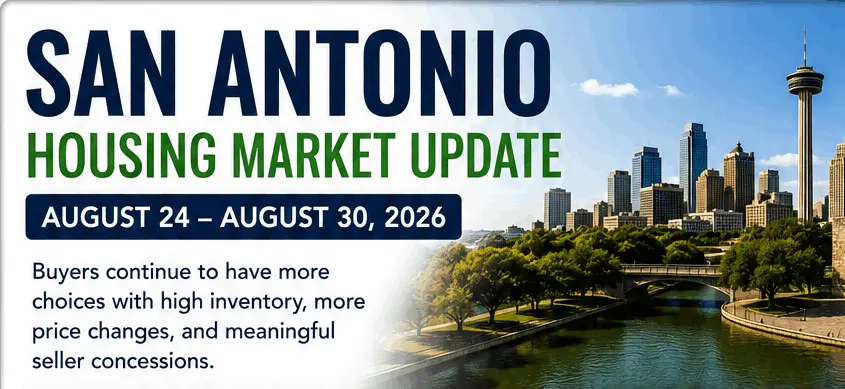
San Antonio Housing Market Update: August 24–30, 2026
If you’re moving to San Antonio and wondering whether buyers still have negotiating power as we head toward fall, this week’s numbers give us a pretty clear answer: yes, but you need to know where to look for it.
San Antonio buyers continue to have a large selection of homes, more than 2,200 listings changed price this week, and sellers contributed more than $10,000 on average toward buyer expenses on closed transactions.
At the same time, mortgage rates moved higher, making the way you structure your offer even more important.
Here’s what happened in the San Antonio housing market from August 24 through August 30, 2026, and what I think buyers relocating to San Antonio should pay attention to right now.
San Antonio Housing Market Snapshot
This week’s single family residential activity included:
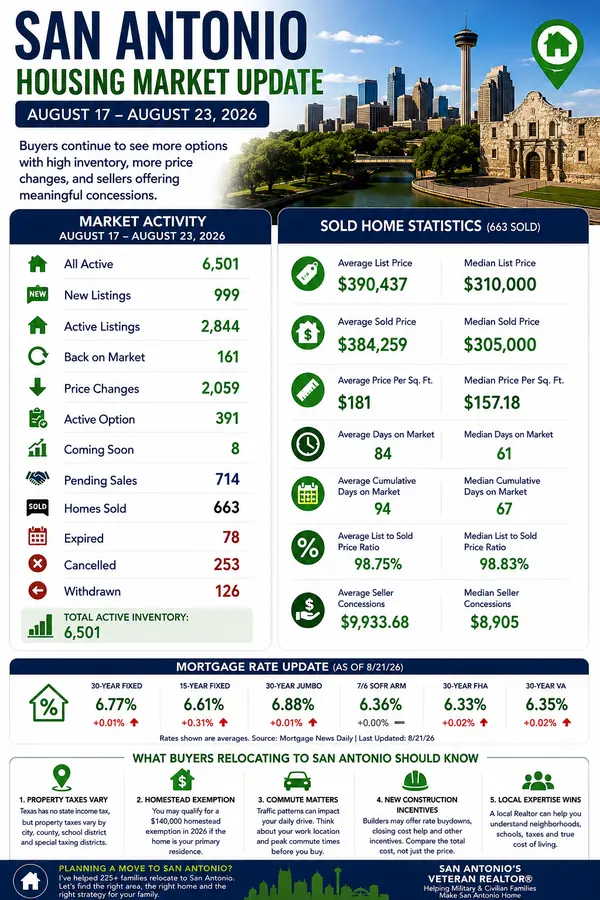
🏡 6,352 active homes
🆕 934 new listings
↩️ 203 homes back on the market
📉 2,243 price changes
📝 363 homes in Active Option
⏳ 684 pending sales
🔑 733 homes sold
❌ 398 cancelled listings
One of the most important numbers here isn't the number of homes sold.
It's the 2,243 price changes.
That's more than three times the number of homes that closed this week.
For buyers, that signals a market where many sellers are still having to respond to competition. Homes that aren't positioned correctly on price, condition or location may need to adjust before attracting a buyer.
And if you're relocating to San Antonio, that's exactly the kind of information we can use when deciding where there may be room to negotiate.
Home Prices: The $300K Mark Stands Out This Week
Among the 733 single family homes sold, here's what the numbers looked like:
Median list price: $300,000
Median sold price: $300,000
Average list price: $382,229
Average sold price: $372,114
Median price per square foot: $154.70
Average price per square foot: $177.29
The median list and sold prices were both exactly $300,000.
At first glance, that might make it look like sellers aren't negotiating.
But that's why I never recommend looking at one statistic in isolation.
The average sold price was more than $10,000 below the average list price, there were 2,243 price changes during the week, and sellers were still contributing significant concessions.
The negotiation may have happened before the final asking price you see attached to the closed sale.
Homes Are Taking Longer to Sell
This week's closed homes spent:
65 median days on market
70 median cumulative days on market
85 average days on market
99 average cumulative days on market
That matters.
A home that's been listed for 70, 80 or 100+ days creates a very different negotiating situation than a home that hit the market yesterday.
For relocating buyers, I like to look beyond the current listing.
How long has it actually been available?
Has it been withdrawn and relisted?
How many times has the seller reduced the price?
Is the property vacant?
Is it competing against new construction?
Did a previous contract fall through?
Those details can tell us far more about a seller's potential motivation than the asking price alone.
Seller Concessions Are Back Above $10,000
Here's the number I'd pay especially close attention to this week:
Average seller concessions: $10,238
Median seller concessions: $9,572
We've consistently seen seller contributions around the $10,000 range in recent weeks.
That's significant.
Depending on your loan program and transaction, seller concessions may potentially help cover allowable closing costs, prepaid expenses or an interest rate buydown.
For some buyers, negotiating a concession can make more financial sense than negotiating the same amount off the purchase price.
For example, reducing the purchase price by $10,000 usually doesn't reduce your monthly payment by $10,000 worth of impact.
Using seller funds strategically toward financing or closing expenses can potentially create a much more noticeable short term benefit.
Your lender should run both scenarios so you can see the actual numbers before deciding how to structure an offer.
Mortgage Rates Moved Higher This Week
Mortgage News Daily's August 28 survey showed mortgage rates rising following the Jackson Hole speech.
The reported averages were:
30 year fixed: 6.81%
15 year fixed: 6.35%
30 year jumbo: 6.90%
FHA: 6.37%
VA: 6.37%
The 30 year fixed rate increased by 0.06 percentage points.
For buyers, this is another reminder that mortgage rates can change quickly.
Rather than trying to perfectly predict where rates will go next, I encourage my clients to focus on whether the home and payment make sense today.
If rates eventually fall, refinancing may become an option, but I would never recommend purchasing a home based on the assumption that you'll definitely be able to refinance later.
Moving to San Antonio? There's a New Commute Issue to Put on Your Radar
Here's something buyers researching neighborhoods online may not know yet.
TxDOT is preparing to begin a major $156 million improvement project around I-410, US 281 and San Pedro Avenue in north central San Antonio. The project covers portions of I-410 between West Avenue and Broadway and US 281 between I-410 and East Nakoma Drive. Construction is expected to begin in fall 2026 and continue through 2029. (TxDOT)
Why does that matter if you're buying a house?
Because this corridor connects areas around the San Antonio International Airport, North Central San Antonio, Castle Hills and major employment areas.
Temporary traffic changes are expected during construction. (TxDOT)
If you're relocating for work and considering neighborhoods that rely heavily on 410 or 281, that's something I would factor into your commute expectations.
This is exactly why I tell relocation clients:
We start at the gate.
Before we start choosing houses, I want to know where you need to be every day.
If you're PCSing to Randolph AFB, Lackland AFB or Fort Sam Houston, or relocating for a civilian job near USAA, UTSA, the Medical Center or another major employment center, your commute should help determine where we search.
North San Antonio Buyers Are Also Seeing Major Transportation Changes
Loop 1604 has been another major consideration for buyers relocating to the north and northwest sides.
TxDOT's Loop 1604 North Expansion included the new diverging diamond interchange at Blanco Road, with final construction scheduled for completion in late summer 2026. The project is designed to improve traffic flow through one of North San Antonio's busiest intersections. (TxDOT)
Transportation projects aren't necessarily a reason to avoid an area.
In fact, infrastructure improvements can be beneficial long term.
But if you're moving here now, you need to know what your commute could look like during construction, not just what Google Maps says when you're researching neighborhoods from another state.
Property Taxes Can Change What You Can Actually Afford
If you're coming from California, New York, Illinois, Florida, Colorado or another state, don't assume two similarly priced San Antonio homes will have similar payments.
Texas does not have a state property tax. Property taxes are assessed locally, meaning the combination of school district, city, county and special district taxes can vary depending on the property. (Texas Comptroller)
That's why I don't like telling relocation clients:
“You can afford a $450,000 house.”
I'd rather determine the monthly payment you're comfortable with and then work backward.
A $450,000 home with a lower effective tax rate could potentially fit your budget better than a $425,000 home with substantially higher taxes.
The Texas Homestead Exemption Got Even More Valuable
Another important update for homeowners moving to Texas is the state's increased homestead exemption.
Texas school districts are now required to provide a $140,000 residence homestead exemption for qualifying primary residences. Local taxing units may also provide additional exemptions. (Texas Comptroller)
For example, on a home appraised at $300,000, the $140,000 school district exemption would mean school property taxes are calculated as though the home were valued at $160,000. (Texas Comptroller)
There's another detail new Texas homeowners often don't realize.
If you buy after January 1, you may qualify to receive the general residence homestead exemption for the applicable portion of that same tax year if the previous owner wasn't already receiving the exemption. (Texas Comptroller)
It's one of the first things I remind my relocation clients to handle after closing.
Don't Forget to Compare Resale Homes Against New Construction
San Antonio remains a market where resale sellers are competing with builders.
Earlier this summer, for example, David Weekley Homes advertised San Antonio financing promotions on qualifying homes that included rates substantially below prevailing market rates, subject to specific financing, purchase and closing requirements. (David Weekley Homes)
That particular promotion had an August 14 purchase deadline, so it's not a current offer I'd tell a buyer to rely on today.
But it's a great example of why we need to check current builder incentives when you're buying.
A resale home might have a lower asking price.
A new home might offer a financing incentive.
The resale seller might give us $12,000 toward closing costs.
The builder might offer a better rate but have a higher property tax rate.
There's no universal winner.
We need to compare the actual monthly payment and total cost of ownership.
And if you're considering new construction, involve your Realtor before your first builder visit. The builder's salesperson works for the builder. You want someone at the table focused on your interests.
What I'd Tell a Buyer Moving to San Antonio Right Now
This isn't a market where I'd tell buyers to rush.
But it's also not a market I'd automatically sit out.
You have 6,352 active homes, more than 2,200 price changes in one week, homes taking around two months to sell and sellers contributing more than $10,000 on average toward buyer expenses.
Those numbers create opportunities.
The strategy is finding the right property where the numbers work in your favor.
Sometimes that's a home that's been sitting for 90 days.
Sometimes it's a seller who has already moved out of state.
Sometimes it's a property competing directly with a builder.
Sometimes it's new construction with an aggressive financing package.
And sometimes it's the brand new listing that checks every box and is priced correctly, where negotiating too aggressively could cost you the house.
Every property needs its own strategy.
Relocating to San Antonio? We Start at the Gate.
I've helped more than 225 families relocate to San Antonio, and one of the biggest lessons I've learned is that you shouldn't begin a relocation home search by asking:
“Which neighborhoods are the best?”
There's no single answer.
Instead, I want to know:
Where are you working?
How long are you willing to commute?
What's your comfortable monthly payment?
Do schools matter?
Do you want new construction or an established neighborhood?
Do you want amenities or more land?
Are you military and PCSing to one of the JBSA installations?
How long do you expect to own the home?
We start at the gate and work outward from there.
I'm an Air Force veteran, I've personally experienced military moves, and I understand how overwhelming it can feel trying to choose a neighborhood in a city you barely know.
My job isn't simply to help you find a house.
It's to help you understand San Antonio, the market and your options so you can make the right decision for your family.
If you're planning on moving to San Antonio, reach out before you start narrowing down neighborhoods. We'll build your relocation strategy first, then find the home that fits it.
Weekly housing statistics are based on the San Antonio MLS data supplied for this report. Mortgage rates shown are from the Mortgage News Daily data supplied for August 28 and can change daily. Financing, concessions, taxes and incentives vary by borrower, lender, property and transaction.
Categories
Recent Posts






"Molly's job is to find and attract mastery-based agents to the office, protect the culture, and make sure everyone is happy! "