
Moving to San Antonio? How Texas' No State Income Tax Really Affects Your Budget
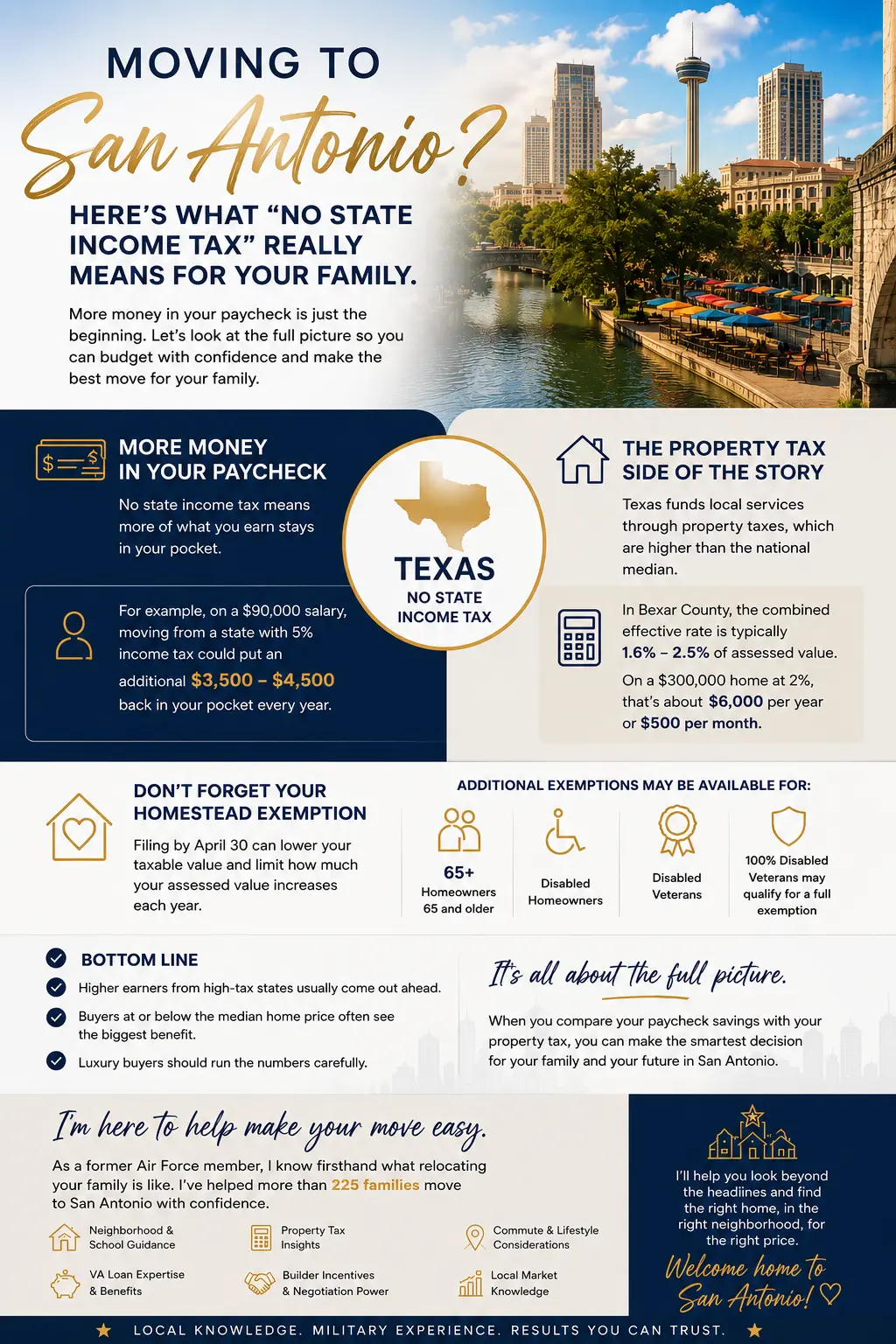
Moving to San Antonio? Here's What "No State Income Tax" Really Means for Your Family
One of the first things I hear from families relocating to San Antonio is, "We can't wait to stop paying state income tax!"
And it's true. Texas is one of only a handful of states with no state income tax, which is one of the biggest financial advantages of moving here. But as someone who's helped more than 225 families relocate to San Antonio, I always tell my clients the same thing:
No state income tax is only part of the financial picture.
Whether you're relocating because of a military PCS, a new job, or simply looking for a better quality of life, it's important to understand how Texas taxes work so there are no surprises after you move.
More Money in Your Paycheck
If you're moving from states like California, New York, Illinois, Oregon, or many others with state income tax, you'll likely notice an immediate difference in your paycheck.
Since Texas doesn't collect state income tax, that deduction simply disappears.
For example, if your household earns around $90,000 per year and you're relocating from a state with approximately a 5% income tax, you could potentially keep an additional $3,500 to $4,500 each year in take home pay before considering other differences in cost of living.
That's one reason San Antonio continues to attract military families, remote workers, healthcare professionals, and companies relocating employees to South Texas.
But Texas Still Has to Fund Local Services
The trade off is property taxes.
Instead of collecting income tax, Texas relies much more heavily on property taxes to fund schools, counties, cities, emergency services, and other local government functions.
In Bexar County, the combined effective property tax rate on a home typically falls somewhere between 1.6% and 2.5%, depending on the neighborhood, school district, city limits, and whether the property is located in a Municipal Utility District (MUD) or Public Improvement District (PID).
For example:
-
A $300,000 home with an effective tax rate of 2% would have an annual property tax bill of approximately $6,000, or about $500 per month, before exemptions.
That's why I never want my clients looking only at the list price of a home. Two homes with identical prices can have very different monthly payments because of property taxes.
One of the First Things I Help My Clients Understand
When families relocate to San Antonio, one of the first conversations we have is about the total monthly payment, not just the purchase price.
We start with your workplace or military installation and work outward, narrowing neighborhoods based on your commute, schools, lifestyle, and budget.
Then we compare things like:
-
Property tax rates
-
HOA fees
-
Insurance costs
-
School districts
-
Commute times
-
Future resale value
Many buyers are surprised to learn that moving just a few miles can significantly change their monthly payment because of different taxing entities.
That's why local knowledge matters.
Don't Forget Your Homestead Exemption
One of the biggest mistakes I see new Texas homeowners make is forgetting to file their Homestead Exemption.
If the home will become your primary residence, filing this exemption with the Bexar County Appraisal District can reduce your taxable value for school district taxes and help lower your annual property tax bill.
It also limits how much your home's assessed value can increase each year for tax purposes, which becomes especially valuable as home values appreciate.
Additional exemptions may also be available for:
-
Homeowners age 65 and older
-
Disabled homeowners
-
Disabled veterans
Veterans with a qualifying 100% disability rating may qualify for a full exemption from property taxes on their primary residence.
This is something I walk my clients through after closing because many people relocating from other states don't realize they need to file for it.
Is Living in Texas Actually Less Expensive?
The honest answer is that it depends.
For many families relocating from higher tax states, the answer is yes.
Higher income households often benefit the most because their income tax savings can easily outweigh higher property taxes.
Families purchasing homes at or below the San Antonio median price also tend to see significant savings compared to many larger metropolitan areas.
If you're shopping in the luxury market, however, it's important to run the numbers carefully since higher valued homes naturally come with larger property tax bills.
Why My Clients Appreciate Having a Local Relocation Expert
After serving 23 years in the Air Force and moving my own family multiple times, I understand how overwhelming relocation can feel.
I've now helped more than 225 families relocate to San Antonio, and my goal is to make your move as informed and stress free as possible.
My clients don't just receive home tours.
They receive guidance on:
-
Which neighborhoods fit their commute and lifestyle
-
Understanding property taxes before making an offer
-
School district comparisons
-
VA loan strategies and benefits
-
Builder incentives and seller concessions
-
Market trends that impact negotiating power
-
Local insight you simply won't find on Zillow
Every relocation is different, and I believe buying a home starts long before you step inside one.
Let's Run the Numbers Together
If you're thinking about relocating to San Antonio, I'd be happy to help you compare your current cost of living with what it could look like here.
We'll look beyond the headline of "no state income tax" and calculate the numbers that actually matter, including estimated monthly payments, property taxes, commute options, neighborhood comparisons, and available buyer incentives.
That way, you can make your move with confidence and know exactly what to expect before you ever arrive in San Antonio.
Categories
Recent Posts






"Molly's job is to find and attract mastery-based agents to the office, protect the culture, and make sure everyone is happy! "